
Best SEO Strategies for Spinal Decompression Practices (Sciatica + Chronic Back)
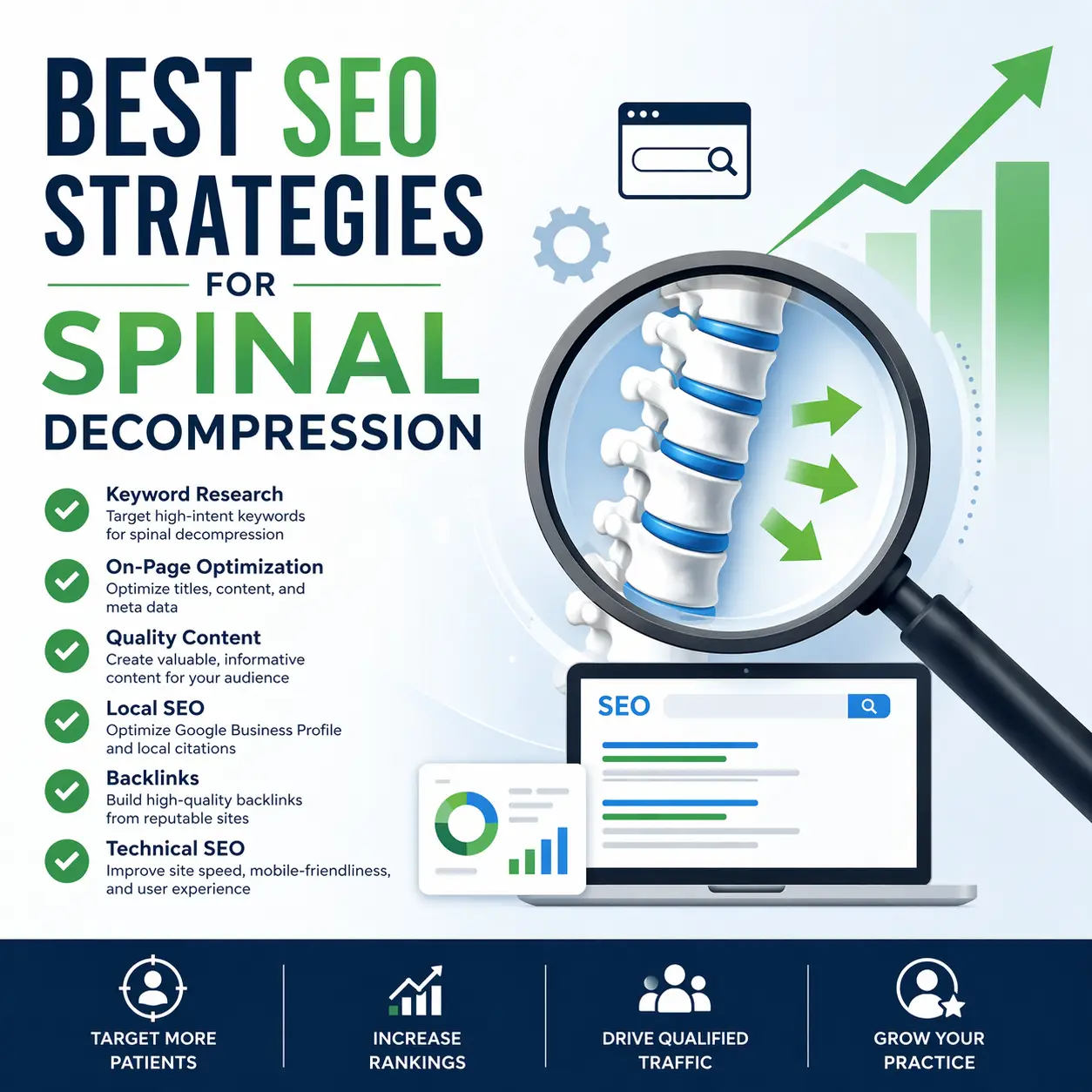
A 15-tactic playbook for decompression programs — built for high-ticket cash-pay economics, long research cycles, and YMYL standards. Not generic chiro SEO with a new keyword.
Why Decompression SEO Is a Different Beast
Spinal decompression is not general chiropractic. It’s a high-ticket, cash-pay program with a funnel that behaves like elective surgery. The buying cycle runs 6 to 12 months. Thin copy loses to long-form pages that teach while the reader works up to $3,000 to $8,000 in cash.
Chronic-pain content sits inside YMYL. Google rewards author attribution, DC credentials, and peer-reviewed citations. Regulatory context matters too: DRX9000 and similar traction tables are 510(k)-cleared — a trust signal framed correctly, a liability conflated with treatment guarantees. Trust wins: deeper pages with clinical substance, named authors, HIPAA case studies, cost transparency, and architecture that separates sciatica, herniated disc, and the program into interlinked entities.
The 15 Best SEO Strategies for Spinal Decompression Practices
Ranked by impact on rankings and cash-pay conversions.
1 Separate Sciatica and Spinal Decompression Pages
Sciatica is a symptom cluster. Decompression is a treatment modality. Collapse them onto one URL and the page ranks for neither. Give sciatica its own page (condition, causes, symptoms, treatment options) and decompression its own page (mechanism, candidacy, equipment, outcomes). Interlink. Highest-impact single fix for most decompression sites.
2 Long-Form Educational Content at 2,000-3,000 Words
Decompression research pages need depth. Readers compare options over weeks; 400-word pages read like upsell copy. Proven range for pages like non-surgical treatment for herniated disc: 2,000 to 3,000 words with clear H2/H3 hierarchy, entity disambiguation, anatomical illustrations, and embedded FAQs. Long-form earns disproportionate link equity.
3 FDA-Clearance Messaging Where Applicable
When the clinic uses a 510(k)-cleared device (DRX9000, Accu-Spina, Triton DTS), reference that clearance as a compliant trust signal. Phrase factually: the equipment is FDA-cleared for lumbar and cervical decompression under 510(k). Never claim the practice or outcome is FDA-endorsed. Add a short equipment-and-clearance section on every treatment page — exactly what safety-searching patients want.
4 Before-Surgery and Surgery-Alternative Content Framing
Top-converting positioning is surgery alternative, not pain relief. Research-cycle patients are past medications and PT, now googling whether they can avoid surgery. Pages framed as non-surgical alternatives to lumbar microdiscectomy outperform generic relief pages on ranking and conversion and position the practice as conservative-first.
5 Herniated Disc Recovery Content Cluster
Build a 6 to 10 page cluster: what a herniated disc is, symptoms, stages, imaging, conservative vs surgical treatment, recovery timelines, exercises to avoid, decompression as a pathway. Interlink aggressively. Herniated disc keyword families generate 10 to 20x more long-tail traffic than spinal decompression alone. A decompression page isolated from disc pathology content underperforms by design.
6 Non-Surgical Sciatica Relief Content Cluster
Sciatica queries dwarf decompression queries roughly 8 to 1. A cluster covering non-surgical sciatica relief, sciatica exercises to avoid, how long sciatica lasts, and decompression for sciatica captures patients earlier and routes them into the program via internal linking. Largest research-stage traffic source for most decompression practices.
7 Mechanism-of-Action Video with VideoObject Schema
A 2 to 4 minute video explaining negative intradiscal pressure, nutrient diffusion, and nerve root decompression earns on-site engagement and AI Overview citations when marked up with VideoObject schema. Embedded videos often rank for how does spinal decompression work. VideoObject markup with thumbnail, duration, and description strengthens AI-summary extraction.
8 Detailed FAQ on Safety and Effectiveness
Safety and effectiveness questions dominate pre-booking research. A dedicated FAQ page plus embedded FAQ sections — is decompression safe, does it work, what does a session feel like, contraindications, recovery — answers the objections patients bring to consultation calls. YMYL scrutiny rewards thorough, honest answers. FAQPage schema earns People Also Ask visibility.
Need a full decompression SEO audit? A prioritized plan mapped to cash-pay economics and YMYL standards.
9 Author Attribution with DC Credentials
Every clinical page needs a named byline: Dr. [Name], DC, [X] years of decompression experience, linked to a full About page. YMYL pages without attribution are being suppressed, and Perplexity and ChatGPT Search cite named authors over unattributed pages. Highlight device-specific training and post-graduate spinal rehab coursework.
10 HIPAA-Compliant Case Study Pages
Consented, de-identified case studies are the highest-converting content type for high-ticket decompression programs. Structure each around condition, baseline symptoms, protocol, session count, and outcome — within the bounds of written authorization. Pair with an outcomes disclaimer. They rank for long-tail queries like herniated L4-L5 disc recovery and convert because real outcomes validate the program.
11 Qualification Content (Candidate vs Non-Candidate)
Not every patient is a decompression candidate, and saying so openly is one of the strongest trust moves available. A “Who is a candidate?” page covering indications (herniated disc, bulging disc, sciatica, lumbar radiculopathy) and contraindications (fracture, tumor, severe osteoporosis, pregnancy, fusion hardware) pre-qualifies bookings, cuts no-shows, and ranks for the high-intent question.
12 Cost and Insurance Transparency
Decompression is cash-pay at $3,000 to $8,000, and hiding that costs more rankings and bookings than disclosing it. Patients search spinal decompression cost in volume outpacing many condition queries. Publish a transparent page covering pricing, what’s included, financing, and why insurance typically does not cover it. Transparency ranks; opacity loses.
13 Internal Linking Across the Decompression Hub
The decompression hub, sciatica pages, herniated disc cluster, and qualification page should be tightly interlinked with descriptive anchor text. Sub-condition pages link up; the decompression page links down to the conditions it treats. Google reads internal linking for topical hierarchy. Weak linking is why many deep sites underperform tighter ones.
14 Review Funnel Specific to Decompression Outcomes
Generic Google reviews help the map pack. Decompression-specific reviews mentioning program, condition, session count, and outcome help rankings and conversion at a different level. Prompt completed-program patients to name their condition and experience. Target 2 to 4 decompression-specific reviews per month to compound trust across GBP and review schema.
15 Backlinks From Medical Education and Patient Advocacy
Link quality matters more on YMYL than anywhere else. Directory links do almost nothing. Links from medical education, patient advocacy, CE providers, PT resource sites, and credentialed health publishers move rankings measurably. Leading tactics: expert-quote contributions (SpineUniverse, SpineHealth), guest posts, resource-page outreach, and citations earned by original outcome data. One high-authority link outpunches 50 directory links.
At-a-Glance Comparison of the 15 Strategies
Priority, time-to-impact, and difficulty — sequence quick wins first, queue compounding plays behind them.
| # | Strategy | Priority | Time to Impact | Difficulty |
|---|---|---|---|---|
| 1 | Separate sciatica and decompression pages | High | 60-120 days | Moderate |
| 2 | Long-form 2,000-3,000 word educational pages | High | 90-180 days | High |
| 3 | FDA-clearance messaging where applicable | High | 30-90 days | Low |
| 4 | Surgery-alternative content framing | High | 120-180 days | Moderate |
| 5 | Herniated disc content cluster | High | 120-240 days | High |
| 6 | Non-surgical sciatica cluster | High | 90-180 days | Moderate |
| 7 | Mechanism-of-action video with VideoObject schema | Medium | 90-180 days | Moderate |
| 8 | Detailed safety and effectiveness FAQ | High | 60-120 days | Moderate |
| 9 | DC author attribution with experience | High | 60-120 days | Low |
| 10 | HIPAA-compliant case study pages | High | 120-240 days | High |
| 11 | Candidate vs non-candidate qualification content | High | 90-180 days | Moderate |
| 12 | Cost and insurance transparency ($3,000 to $8,000) | High | 60-120 days | Low |
| 13 | Internal linking across decompression hub | High | 60-120 days | Low |
| 14 | Decompression-specific review funnel | Medium | 90-180 days | Moderate |
| 15 | Medical-education and advocacy backlinks | Medium | 180-360 days | High |
The Decompression SEO Timeline
The 6 to 12 month buying cycle bends the SEO timeline. Model it correctly and you avoid pulling the plug before the curve turns.
- Months 0-3 — Foundation: Separate sciatica and decompression URLs, stand up clusters with 4 to 6 deep pages, ship author attribution, FDA-clearance messaging, schema, internal linking.
- Months 3-6 — Cluster Completion: Sciatica and herniated disc clusters to 8 to 12 pages each, cost transparency and safety FAQ, case studies and video.
- Months 6-12 — Compounding: Sciatica cluster ranks 1 to 5 for long-tail queries, herniated disc pages compete, program page enters page 1. Consultation volume doubles or triples vs month 6.
- Months 12-18 — Harvest: Site ranks for high-intent commercial queries. AI Overviews cite the site. $3,000 to $8,000 cash-pay programs amortize the investment after a handful of conversions.
Common Mistakes That Sink Decompression SEO
These errors recur across underperforming sites. Most reverse in 60 to 90 days.
1. Hard-Sell Landing With No Educational Layer
Reads like a sales letter. CTAs every 200 words, pricing buried, no mechanism. Research-mode patients bounce. Fix: educate, qualify, convert.
2. Generic Back Pain Content Without Decompression Specificity
Pages cover back pain broadly without explaining what decompression is or who it serves. The site competes with WebMD on queries it cannot win. Fix: shift focus to the specific conditions and treatments delivered.
3. Missing FDA-Clearance Framing
Clinic uses cleared equipment but the site never mentions it. A free trust signal left on the table. Fix: a dedicated equipment-and-safety section on every decompression page, framed around the 510(k) clearance.
4. Weak YMYL Posture
Unsigned content, thin about page, no citations. Google reads low trust and suppresses rankings. Fix: named DC author on every clinical page, full bios, citations where claims are made.
5. Treating Decompression SEO Like General Chiropractic SEO
Same playbook as adjustment traffic — short location pages, generic blogs, directory citations. Rankings stall. Fix: a decompression-specific strategy built on the educational funnel, YMYL standards, and $3,000 to $8,000 cash-pay economics.
Frequently Asked Questions: Spinal Decompression SEO
How long does SEO take to rank a spinal decompression program?
The buying cycle itself runs 6 to 12 months. Educational pages rank in 90 to 180 days for long-tail queries. Commercial-intent pages like spinal decompression cost take 9 to 15 months in competitive metros. Months 0 to 6: cluster building. 6 to 12: compounding. Month 12 onward: harvest window.
Is decompression SEO different because it is cash-pay?
Yes. A $3,000 to $8,000 cash-pay program forces patients into a long research phase, so the funnel has to educate first and sell second. Top-of-funnel content on disc anatomy, sciatica mechanisms, and surgery-alternative pathways outperforms pushy landing copy. Without the educational layer rankings stall and conversions collapse.
How should FDA clearance be mentioned in decompression content?
Reference the device actually used — a 510(k)-cleared traction table like the DRX9000 — and cite the regulatory pathway and cleared indication. Never imply FDA endorsement of the practice. Accurate framing: the equipment is FDA-cleared for lumbar and cervical decompression.
Can I publish patient case studies under HIPAA?
Yes, with properly executed written authorization — specific to the use, signed and dated, and revocable. Best practice: clinical narrative rather than names, no identifiable imaging unless authorized, and an outcomes disclaimer. Consented, de-identified case studies convert at the highest rates.
What YMYL standards apply to chronic back pain content?
Chronic pain and decompression content sits inside Google YMYL scrutiny because clinical decisions ride on it. Google rewards E-E-A-T: named DC author, medical reviewer attribution, peer-reviewed citations, and transparent about pages. Thin or unattributed content is increasingly suppressed.
How do AI Overviews treat decompression queries in 2026?
AI Overviews trigger on roughly 35 to 45 percent of decompression research queries. Citations reward 40 to 70 word answer paragraphs, clear MedicalCondition schema, and factual precision. Practices earning citations ship structured data that disambiguates entity, treatment, condition, and outcome.
How do I build authority for a new program with no backlinks?
Four moves in parallel. Publish 12 to 20 deep educational pages across sciatica, herniated disc, chronic back, and qualification clusters. Earn medical-education and patient-advocacy links via guest contributions, expert quotes, and resource outreach. Collect 30 to 50 decompression-specific Google reviews. Ship schema across MedicalCondition, VideoObject, FAQPage, and Article.
Powered by Stethon Digital Marketing
This playbook traces back to Stethon’s work for US decompression programs running DRX9000, Accu-Spina, and Triton DTS systems. Stethon is a healthcare-specialist agency — why decompression programs here outpace generalist-agency clients on rankings, AI Overview citations, and consultation conversions.
Stethon delivers the full stack: YMYL-grade educational content, FDA-clearance framing, HIPAA-compliant case studies, MedicalCondition and VideoObject schema, and links from medical-education and patient-advocacy sites.
Internal resources:
- Chiropractic SEO services at Stethon Digital Marketing — local SEO, content SEO, technical SEO, and AI Overviews optimization.
- Chiropractic marketing hub at Stethon Digital Marketing — vertical hub linking to spinal decompression, peripheral neuropathy, and knee decompression service pages.
Get a Free Spinal Decompression SEO Audit
Reviews content architecture, YMYL posture, FDA-clearance framing, schema, and keyword footprint — ships a prioritized plan tied to cash-pay program economics.
No obligation. Yours to implement either way.
Related Reading
- SEO for Chiros home: best SEO for chiropractors in 2026 — master playbook across local SEO, technical SEO, content SEO, and AI Overviews.
- Best SEO strategies for back pain chiropractors — sibling playbook on adjustment-based back pain practices and the overlap with decompression candidacy.
- Best SEO strategies for laser therapy and neuropathy — sibling playbook on peripheral neuropathy, Class IV laser, and cash-pay program structure overlapping decompression economics.